Abstract
This work presents a Remote Monitoring Robot for Gait Rehabilitation, adopting a patient-centered approach to robot-assisted gait training while empowering remote clinical oversight. Our system integrates two key elements:
- Rhythmic Auditory Stimulation employs music and rhythm to enhance gait patterns in individuals with gait disorders, aligning with physiotherapy objectives.
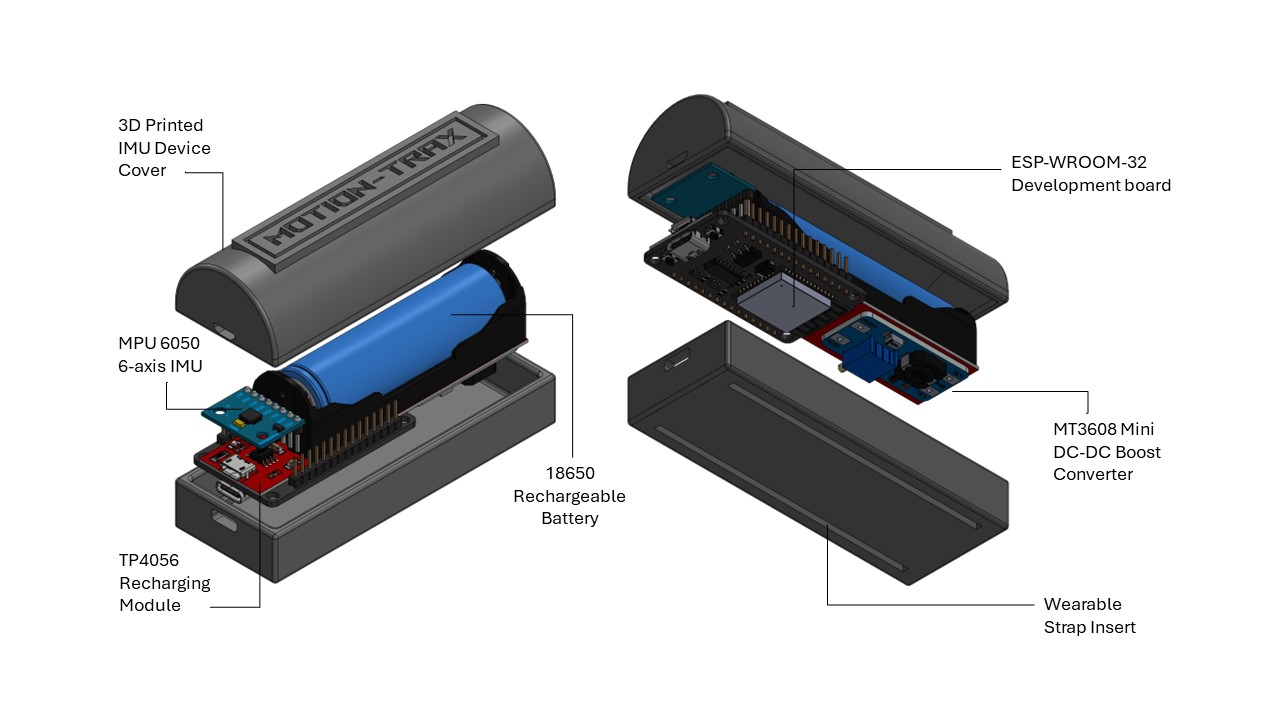
- Remote Gait Monitoring utilizes wearable IMUs for real-time gait data transmission to medical professionals. This enables informed remote care delivery and reduces the necessity for frequent in-person consultations. Crucially, the system provides direct feedback to the user for gait improvement, enabling self-guided training even in the absence of external monitoring.
Detailed Functionalities
- Rhythmic Auditory Stimulation (RAS)
This is a proven method for improving gait disorders and has gained increasing interest in recent years. This approach utilizes the power of music to aid in rehabilitation. Here’s how it works:
- Heel-Strike Detection: The exact moment of heel-strike (HS) within the gait cycle is detected. This information is then translated into a corresponding musical beat.
- User Synchronization: The user listens to the rhythmic beats through headphones and actively tries to synchronize their heel-strikes with the tempo of the music.
- Customized Tempo: The initial tempo is carefully selected to match the user’s comfortable walking capabilities. This personalized approach ensures the user can easily follow along.
- Progressive Challenge: Once the user is comfortable with the set tempo, the speed of the music is gradually increased in 5% intervals. This promotes continuous improvement and challenges the user.
Throughout the process, data is continuously collected to monitor rehabilitation progress. Temporal Gait Parameters such as, Stride length (the distance between successive heel strikes of the same foot), Cadence (Steps per minute), Gait Symmetry (similarity of timing and length of left and right steps), Gait Variability (fluctuations in stride time between steps) are tracked. Spatial Gait Parameters such as, Step width (lateral distance between the heels during walking), Single Limb Support Time (duration one foot is in contact with the ground during a gait cycle), Double Limb Support Time (The period with both feet on the ground) are also tracked.
- Remote Gait Monitoring: Employing wearable IMUs, a solution is designed for medical professionals to remotely track real-time gait data, facilitating informed care and reducing the need for frequent in-person visits.
- Provides feedback for gait improvement to the user even without external monitoring