Abstract
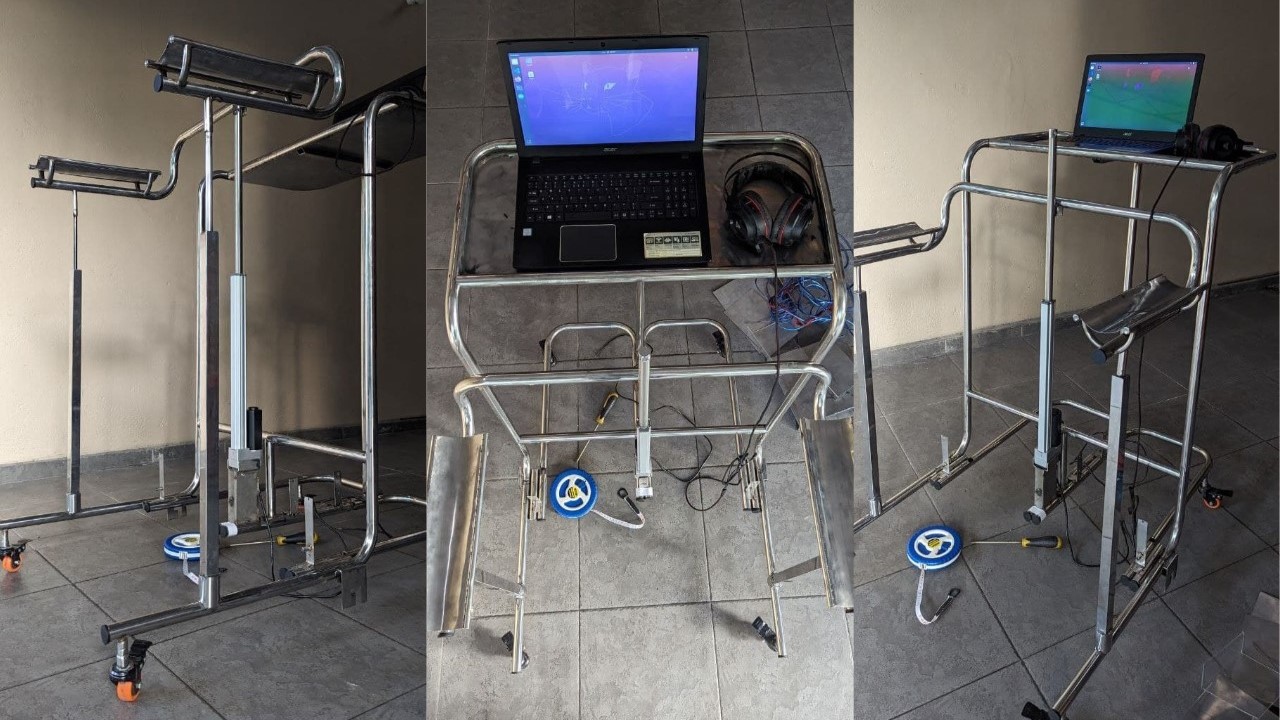
This project presents an autonomous walker designed for individuals with mobility limitations. It utilizes a navigation stack built on Robot Operating System (ROS) for self-directed movement guided by user-specified goals through a multimodal interface combining LiDAR, sound source localization, and computer vision. Additionally, the walker offers a mechanism for sit-to-stand mobility assistance and provides active user guidance through an array of force-sensing resistors. We successfully implemented and configured the ROS stack, fabricated a functional prototype, and conducted structural analysis. Future work focuses on fine-tuned navigation, user studies, and clinical trials to evaluate the system’s potential for real-world application, promoting independence and mobility for users.
Functionalities
- Autonomous User Localization: By successfully integrating LiDAR, sound, and visual sensory data a system that eliminates the reliance on Indoor Positioning Systems is developed to enable the walker to autonomously navigate to the user.
- Active Walking Guidance: Guides the user to avoid obstacles when using the walker while adapting to the user’s pace by incorporating force-sensitive resistors which provide an intuitive control interface. The system can identify emergency user states and mitigate fall risks.
- Sit-to-stand assistance: Using a mechanism to provide standing support upon estimation of user height through human pose estimation.
- Onboard Gait Analysis: Employing a walker-mounted 2D LiDAR, gait analysis is enabled, potentially providing diagnostic data for gait assessment.